Walk down the honey aisle and one word does a lot of heavy lifting: raw. It sits beside "pure", "natural" and "unfiltered" on jars that look nearly identical, yet are priced very differently. The gap between raw and pasteurised honey is real, but it is narrower than the labels imply — and knowing exactly where it matters makes choosing a jar much easier.
What "raw" actually means
Raw honey is essentially honey that has been taken from the comb and strained, rather than put through industrial heat and pressure. Most producers who call their honey raw keep it below roughly 40°C, which is close to the temperature inside a working hive. Warm enough to let it run through a sieve, not warm enough to cook it.
Because it is handled gently, raw honey usually still carries traces of pollen, tiny flecks of wax and propolis, and its natural yeasts. That is why the texture and colour can shift from jar to jar, even within one beekeeper's season. It also means water content matters: honey with too much moisture and live yeasts can ferment over time, so a careful producer tests it before jarring. A well-made raw honey is stable for years; a sloppy one can turn fizzy and boozy in the cupboard.
How pasteurisation changes the jar
Pasteurised honey is heated — often somewhere between 60°C and 70°C, sometimes more — and then fine-filtered under pressure. The heat kills off the yeasts that would otherwise cause fermentation, and the filtering strips out pollen, wax particles and air bubbles.
The results are obvious to the eye. Supermarket honey is typically clear, glossy and uniform, and stays pourable for months on end. It is also easier to blend into consistent batches, which is why so much of it tastes the same regardless of where you buy it.
The trade-off is aroma. The volatile compounds that give honey its floral character are fragile, and heat drives some of them off. Honey that has been pasteurised tastes softer and simpler — pleasant, dependable, but rarely surprising.
Crystallisation: what a set jar is telling you
Crystallisation is not spoilage and it is not a sign of cheap honey. It is what honey naturally does. Glucose separates out into crystals, while fructose stays liquid, and the balance between the two decides how quickly it happens.
Natural rapeseed honey can set solid within weeks. Acacia honey may stay runny for a year or more. Heather honey is famously thixotropic — a gel that sits still in the jar until you stir it, then flows. All three are perfectly good honey.
Pasteurised honey crystallises more slowly, partly because fine filtering removes the tiny particles that act as starting points for crystals. It still sets eventually. So a jar that has gone grainy is not "off"; it is simply less processed.
If you prefer a runny texture, stand the jar in a bowl of warm water — around 40°C is plenty. Avoid the microwave and avoid boiling water, both of which undo the very thing you paid for. Creamed honey, by the way, is crystallised honey stirred finely so it stays smooth and spreadable.
Flavour, aroma and texture
Raw honey tends to be more assertive. You may pick up floral, fruity, herbal or slightly waxy notes, and the finish can be tangy rather than purely sweet. The texture can be slightly grainy or chewy. Because it is less uniform, the same producer's spring and summer harvests can taste noticeably different.
Pasteurised honey is smoother and rounder, with a clean sweetness that fades fairly quickly. That consistency is genuinely useful. In baking, marinades, glazes and dressings, the subtleties of raw honey are largely lost anyway, so there is little point spending more on it.
Where raw earns its money is where you can taste it directly: on toast, stirred through yoghurt, drizzled over cheese, or eaten off a spoon.
Reading a UK honey label
Here is the part that surprises most shoppers: "raw" has no legal definition in UK food law. Neither do "unfiltered", "natural" or "pure" in the way most people assume. You are relying on the producer's honesty and reputation, not on a standard. Some useful signals to look for:
- A named floral source or single origin, such as "Scottish heather" or "borage", rather than a vague "blend".
- The producer's name and county on the front, with a harvest year or batch number.
- A note that the honey may crystallise naturally — a good sign that it has not been over-processed.
- An ingredient list that reads simply "honey". Added sugar is not permitted in anything sold as honey, so anything else on that list deserves a second look.
- "Organic", which is a protected term and independently certified. "Raw" is not.
Blended honey from multiple countries is legal and must be labelled as such, but heavy filtering can make the stated origin hard to verify. That is not automatically a bad jar — it is just a different product from a single-apiary one.
Choosing with confidence
Buy for how you will actually use it. A jar for baking, glazing and stirring into tea can be an everyday pasteurised one. A jar for the table, where you want character, is worth buying raw from a producer you trust.
If you buy at a farmers' market or direct from a beekeeper, ask a few questions. Most are delighted to talk:
- Is the honey heated, and to what temperature?
- Is it strained or fine-filtered?
- Is it from one apiary or a blend of sources?
- When was it harvested?
Store it in a cool, dark cupboard with the lid screwed tight. Refrigeration makes it set faster, and a wet spoon introduces water that can start fermentation, so keep the jar dry.
One safety point worth repeating: honey of any kind should not be given to babies under twelve months old. And raw honey is not a health food in the way the marketing implies — it is still a sugar, so treat it as one. If you are managing blood sugar, raw and pasteurised are much the same, and it is worth speaking to your GP or a registered dietitian rather than relying on label claims.
Beyond that, the decision is simple. Choose raw when you want flavour and character, pasteurised when you want consistency and value, and don't be alarmed when either one sets in the jar.
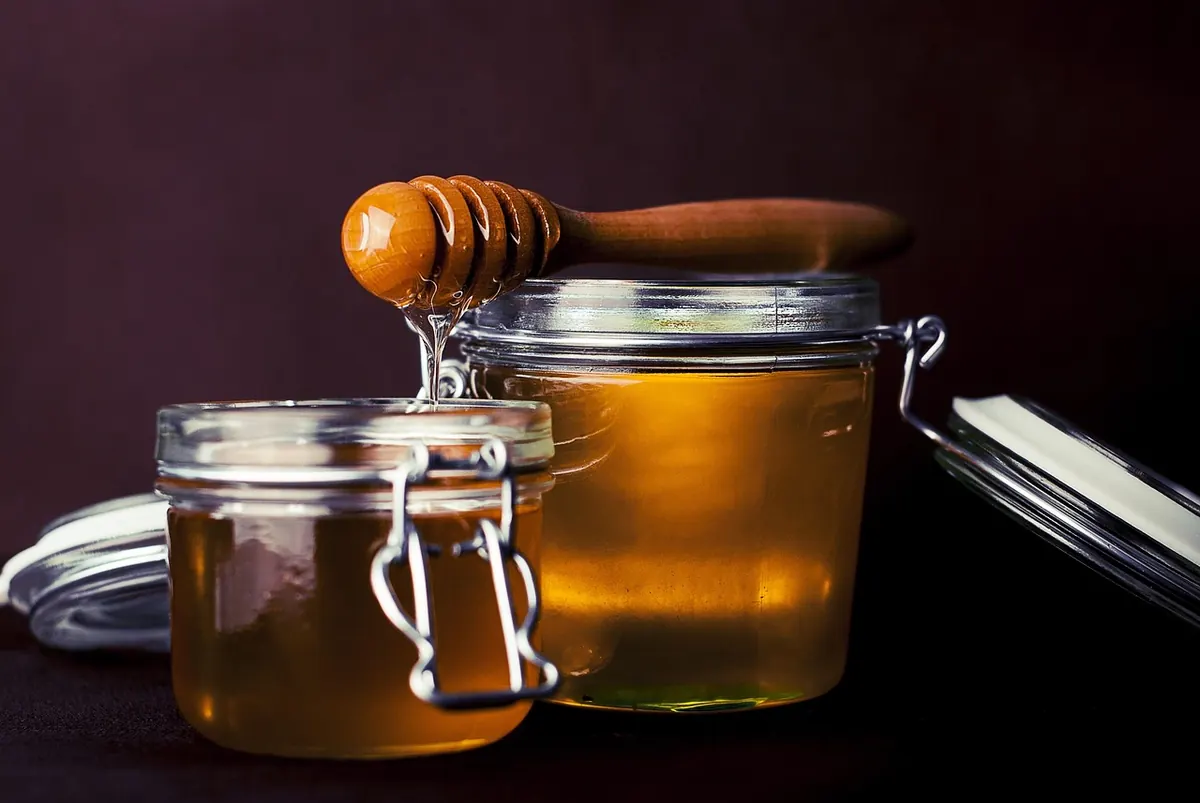
Photo: fancycrave1 / Pixabay